
High Volume Low Calorie Foods: Why kcal per 100 g Decides Everything
September 16, 2026
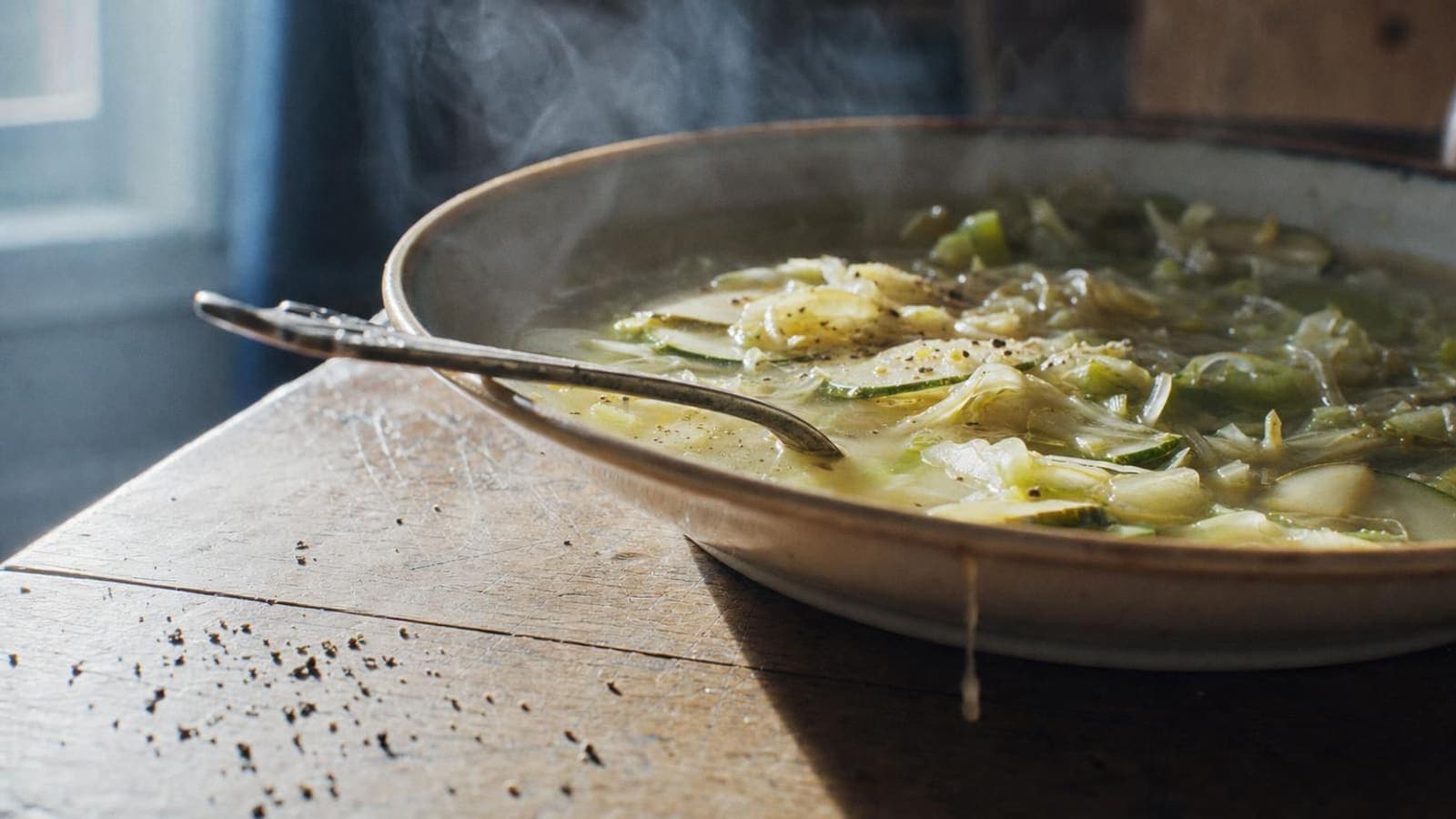
A 300 g bowl of broth-based vegetable soup is about 105 calories. A 300 g bag of potato chips is about 1,600. Identical weight in your hand, identical weight in your stomach, more than fifteen times apart on the label.
That gap has a name, and it is the only thing "high volume eating" is really about. Most articles on this query hand you a numbered list of foods. Here is the number behind the list, what it does and does not buy you, and how much of any of it actually fits in your day.
What "High Volume" Actually Means
High volume is not a food group or a diet. It is a property called calorie density: how many calories sit in 100 grams of a food. Low-density foods carry water, fiber or air, so a large portion still lands at a small calorie total. That is the whole mechanism, and unlike most diet advice it is measurable.
Read any food as kcal per 100 g and the list writes itself. Cucumber is 15. Olive oil is 884. Nothing about the cucumber is virtuous and nothing about the oil is wicked. One is mostly water and one is pure fat, and your stomach measures grams while your body counts calories.
The values below come from USDA FoodData Central, rounded. Raw or cooked matters: 100 g of dry oats is 389 kcal, and the same oats cooked into porridge are about 71, because you added water.
The Foods, Grouped by What Makes Them Low Density
Three mechanisms do the work: water, fiber and air. Water is the strongest by far, which is why soups and raw vegetables sit at the bottom of the table and why "just add more salad" is better advice than it sounds. Fiber adds bulk and slows the meal down. Air is the odd one out, and it has a catch.
Water-heavy (15 to 40 kcal per 100 g)
| Food | kcal / 100 g | Why |
|---|---|---|
| Cucumber | 15 | ~96% water |
| Lettuce, romaine | 17 | water plus leaf volume |
| Zucchini | 17 | ~94% water |
| Tomato | 18 | ~94% water |
| Spinach, raw | 23 | water, huge raw volume |
| Cabbage | 25 | water plus fiber |
| Watermelon | 30 | ~91% water |
| Strawberries | 32 | water plus fiber |
| Broth-based vegetable soup | ~35 | water carried into the meal |
Fiber-heavy (35 to 135 kcal per 100 g)
| Food | kcal / 100 g | Why |
|---|---|---|
| Broccoli | 34 | fiber and water |
| Carrot | 41 | fiber and water |
| Raspberries | 52 | one of the highest-fiber fruits |
| Potato, boiled | 87 | starch plus water, very filling per calorie |
| Oatmeal, cooked | 71 | dry oats plus water |
| Lentils, cooked | 116 | fiber plus protein |
| Black beans, cooked | 132 | fiber plus protein |
Protein with water (50 to 90 kcal per 100 g)
| Food | kcal / 100 g | Why |
|---|---|---|
| Egg white | 52 | protein, almost no fat |
| Greek yogurt, plain 0% | 59 | protein plus water |
| Cod, white fish | 82 | protein, very little fat |
Air, and the catch
Air-popped popcorn is the food every list includes and every list explains badly. By weight it is 387 kcal per 100 g, which is high. By volume it is enormous: a 30 g portion is about 116 calories and fills a large mixing bowl. Popcorn is the one case where kcal per 100 g misleads you, because you never eat 100 g of it. Judge it per portion, not per gram.
For contrast, the other end of the scale: olive oil 884, peanut butter 588, almonds 579, potato chips 536, cheddar 403, avocado 160. These are not foods to avoid. They are foods to measure.
How to Feel Full on 1,200 Calories a Day
Build the plate backwards. Start with 300 to 400 g of water-heavy vegetables, add 100 to 150 g of a lean protein, then add the starch, then add the fat last and weigh it. A bowl of broth-based soup before the main course is the single most reliable trick, and it is the one Barbara Rolls's energy-density research at Penn State kept finding (Physiology & Behavior, 2009).
Two smaller habits do more than they look like they should. Eat the vegetables first rather than saving them for last. And drink water with the meal instead of calories: a 330 ml soda is roughly 139 kcal that leaves no trace of fullness at all.
A caution belongs right here, before the tactics sound like a target.
The Floors: 1,200 for Women, 1,500 for Men
Whatever the arithmetic says, do not eat below 1,200 calories a day as a woman or 1,500 as a man without medical supervision. Below those numbers the hard part stops being hunger and becomes nutrition: protein, iron, calcium and B12 get difficult to cover from food, however well you fill the plate.
This is worth saying plainly because the search results rarely do. "How to feel full on 1,200 calories" is asked by men too, and 1,200 is already under the floor for them. Volume eating cannot fix an intake that is too low. It only makes a low intake more comfortable, which is a different thing, and being comfortable at an unsafe number is not an improvement.
The Mistake That Cancels the Whole Thing
One tablespoon of olive oil is about 124 calories. Poured over a 60 calorie salad, it triples the plate in a second and a half. Thirty grams of cheddar adds about 121. Two tablespoons of peanut butter add about 188. None of that is wrong to eat. What is wrong is doing it while believing the meal is still a low-calorie meal.
This is where most high-volume plates quietly fail. The vegetables get chosen carefully and the dressing gets poured by feel. If you weigh one ingredient in your kitchen, weigh the fat.
What Volume Eating Does Not Do
It does not create a calorie deficit. It makes one liveable. You lose fat when you eat below what you burn, and roughly 7,700 calories of deficit corresponds to about a kilogram of body fat. High-volume foods change how that deficit feels, not whether it exists.
That distinction matters because it predicts who this works for. If your problem is that you end the day hungry and eat something at 10pm, calorie density is your lever. If your problem is portions of calorie-dense food you are not counting, the lever is the scale and the sums, and swapping in more cucumber will not touch it.
The usual deficit sizes are 275, 550 or 825 calories a day, which is a gentle, standard or aggressive pace. Pick the pace you can hold for three months, not the one that looks fastest in week one.
When High Volume Is the Wrong Move
Three cases, and they are common enough to name. If you have reflux, IBS or another gut condition, large volumes and a sudden jump in fiber often make symptoms worse, not better. If you are underweight, recovering from illness or in a phase where eating enough is the actual problem, filling up on water-heavy food works directly against you.
And if you train hard, you can genuinely struggle to eat enough. An athlete on 3,200 calories a day who builds every meal out of soup and salad ends up under-fuelled and tired. Calorie density is a tool that points both ways. Some people need to turn it up.
Meals, Snacks and Breakfasts, Not Just Ingredients
Ingredients are where this gets abstract. A list of vegetables is not dinner, and nobody eats cucumber as a meal. The translation is easier than it looks: keep the structure of the food you already eat and change the ratio inside it.
Breakfast. Plain Greek yogurt with 150 g of berries is roughly 165 calories and takes ten minutes to eat. Porridge made with water instead of milk saves about 60 calories per bowl.
Snacks. A large bowl of air-popped popcorn, a whole cucumber with a spoon of yogurt dip, or 200 g of watermelon all land between 60 and 130 calories.
Dinner. This is where the volume actually pays, because dinner is where most people overshoot. Our high protein low calorie meals collection is ten exact dinners with quantities and macros, each under 500 calories with at least 25 g of protein.
Vegetarian. Lentils and black beans at 116 and 132 kcal per 100 g do the fiber and the protein at once, which is why they replace meat in this style of eating more comfortably than a meat substitute does.
Start With Your Own Number
A food list is only actionable once you know your own daily target, because "low calorie" is meaningless without the total it fits inside. At 1,600 calories a day, a 60 calorie bowl of soup is nothing. At 1,200 it is 5% of the day. Same bowl, different decision.
Your target is built in two steps. The Mifflin-St Jeor equation gives your resting burn from 10 × weight in kg + 6.25 × height in cm − 5 × age, plus 5 for men or minus 161 for women. Multiply that by an activity factor between 1.2 and 1.9, then subtract your deficit of 275, 550 or 825.
Or skip the arithmetic: our free calorie calculator does both steps and hands you the number in about a minute. Once you have it, an algorithm-built personalized meal plan turns it into actual meals with quantities and a grocery list, which is the step where "eat more vegetables" becomes a day you can repeat.
This article is not intended for pregnant or breastfeeding people, adolescents, or anyone with a medical condition, who should talk to a doctor first.
This is general information, not medical advice. If you have a medical condition, talk to your doctor or a registered dietitian before changing your diet.
Common questions
- What foods are filling but low in calories?
- Foods that carry a lot of water, fiber or air. Broth-based soups, leafy greens, cucumber, berries, air-popped popcorn, plain Greek yogurt, egg whites and white fish. A 300 g bowl of vegetable soup and a 300 g bag of chips weigh the same in your hand and sit more than ten times apart in calories, roughly 105 against roughly 1,600.
- Is 1,200 calories a day too little?
- For most women 1,200 kcal is the usual floor and for most men it is 1,500 kcal. Below those numbers the problem stops being hunger and becomes getting enough protein, iron and calcium. If your calculated target lands under them, talk to a doctor before eating there.
- Does volume eating actually help you lose weight?
- It helps you stay in a deficit, which is the part most people find hard. It does not create the deficit on its own. You still have to eat fewer calories than you burn. High-volume foods make that number easier to live with day after day.
- How much of these foods fits in my day?
- That depends on your own target. At 1,600 kcal a day, a 60 kcal bowl of soup and a 90 kcal serving of berries barely move the total. Our free calculator gives you your daily figure from your height, weight, age, sex and activity.